Showing posts with label NYS Historic Markers. Show all posts

Thursday, April 16, 2020

Eaton Markers, Samuel de Champlain & Our Local History

The missing NYS Historic Markers in Eaton are listed online at the NY History Site. They were erected when the New York State Education Department was doing a project in the 30's. They erected some of these markers as guideposts to historic areas, one such area was Nichol's Pond.  

This area for many years was considered a battle site that dated back to 1615 and the times of French explorer Samuel de Champlain.  One such marker stood in Eaton near the crossroads of Rt. 26 and Morrisville-Eaton Road. Another of these markers still stands at the crossroads in Cazenovia that reads "Site of a Champlain Battle" with arrow.

This battle supposedly took place at today's Nichol's Pond Park.  The park is located in the Town of Fenner and is one of Madison County's only county parks.  Today it has many historical markers, with information on the site that explains the Iroquois Village that sat there and the possible  battle.  This information however, does not come with out controversy.

Early historians took trips to the site for many years to dig for artifacts, including noted historians Mrs. Hammond, and Mr. Houghton. Their thought was this was the site of an early battle with Champlain and 300 Huron Warriors who attacked the Oneida Village in 1615.  Other historians and archaeologists said no because there was no metal found at the site.  Still others think it is one of the earliest Iroquoian village sites we have in Central New York.  This history battle has raged for years..so actually it is a battle site one way or the other. I myself could care less one way or another...I think it is a fabulous historic treasure and part of our heritage.

What stands out to me  and most visitors I suspect, is its antiquity, its quiet solitude, its ancient grain pits and springs....it is Madison County's best link to its former inhabitants...and its past!

Here is a video I did of the park you might enjoy - since we are home-sheltering.


Tuesday, March 31, 2020

More on Early Settlement and the Mills

The history of settlement in many of our early communities formed around lush rich soil, water bodies or old transportation routes, in some cases around something as simple as mineral deposits like “salt”.

In early times a salt source or spring was sought and early settlers flocked to it to boil off water to gain a cup of the needed mineral.  Salt in colonial times was as valuable as gold as a source of money or for trade. Salt as a trade-ware is traced as early as 6050 BC.  Salt is a need mineral for man or animal…needed to dry meat and preserve fish, it was also needed to make many other components of life.  From the history of salt in America we find from “SALT WORKS”  – History of Salt….. 

Salt motivated the American pioneers. The American Revolution had heroes who were salt makers and part of the British strategy was to deny the American rebels access to salt. Salt was on the mind of William Clark in the groundbreaking Lewis and Clark expedition to the Pacific Northwest. The first patent issued by the British crown to an American settler gave Samuel Winslow of the Massachusetts Bay Colony the exclusive right for ten years to make salt by his particular method. The Land Act of 1795 included a provision for salt reservations (to prevent monopolies), as did an earlier treaty between the Iroquois' Onondaga tribe and the state of New York. New York has always been important in salt production.”

The settlement of Eaton sprang up around its water sources, since it was water that powered the mills.
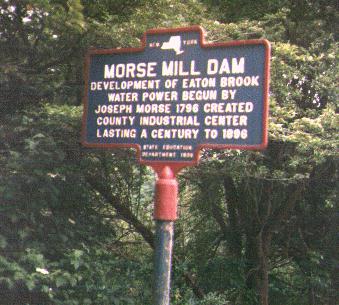
Joseph Morse moved to this side of the Chenango to take advantage of the flow of water from the Eatonbrook.  He staked his fortune on making the needed mills, that included a gristmill, lumber mill, woolen mills and a cotton mill. 
History is in some ways is a road sign to the future. It seems that as a historian you are continually seeing the current happenings in a context of what has transpired in the past and then predicting what will happen in the future.  In every small town in rural America we can see that past disappearing before our eyes.  Sitting here at night writing I wonder if perhaps there might be a rebirth of the rural small communities as more and more people do business from home and seek out peaceful setting to escape to. 


Here in Eaton we have the reservoirs and small lakes that in the past filled with only summer people…but more and more of these “camps” are becoming year round homes.  As the suburbs inch closer and our electric & Internet improve… I wonder if some of these areas like Eaton might have a new rebirth.